Finley Meier · 21 October 2026
Tidal Diaries: Retired Fishers Pass Down Willow Bay's Shifting Currents to Young Researchers
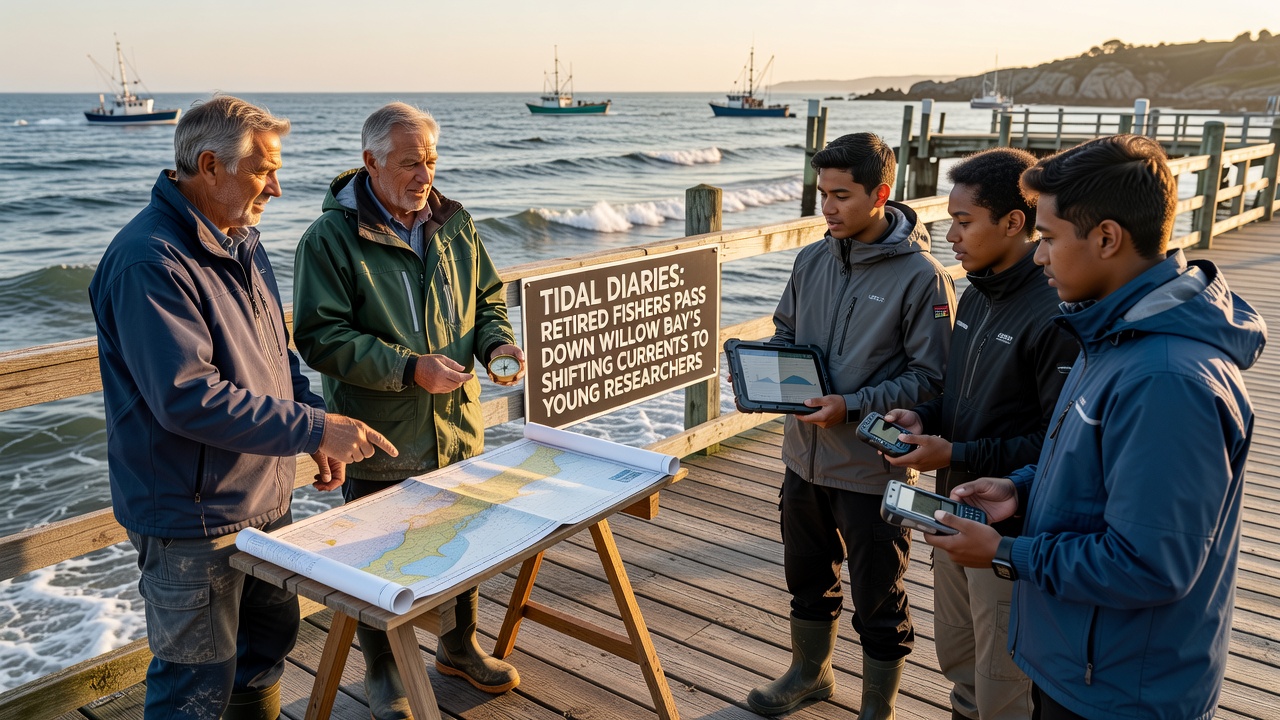
Retired fishers in Willow Bay have begun sharing decades of handwritten tidal observations with university teams and local marine science programs, and this exchange takes shape through a collection known as the Tidal Diaries. The diaries contain daily notes on current speeds, wind shifts, and water level changes that fishers recorded during their working years, and researchers now use these entries to supplement instrument data collected since the early 2000s. Programs built around the diaries run year-round, with a focused workshop series scheduled for October 2026 that pairs each retired fisher with a graduate student for direct review of specific logbooks.
Origins of the Tidal Diaries Project
Local fishers started the diaries in the 1970s as personal records to track safe passage through shifting sandbars and narrow channels, and the practice continued until many vessels left the bay in the 2010s. Community organizers collected more than 180 volumes in 2024, and archivists at the regional marine history center digitized every page while preserving the original notebooks. Data from the diaries include measurements taken at fixed points along the north and south shores, and cross-checks against tide gauge records maintained by the National Oceanic and Atmospheric Administration show close agreement on average high-water times. One study released by Fisheries and Oceans Canada in 2025 confirmed that the handwritten current estimates matched acoustic Doppler readings within 0.2 knots during calm conditions.
How Knowledge Moves Between Generations
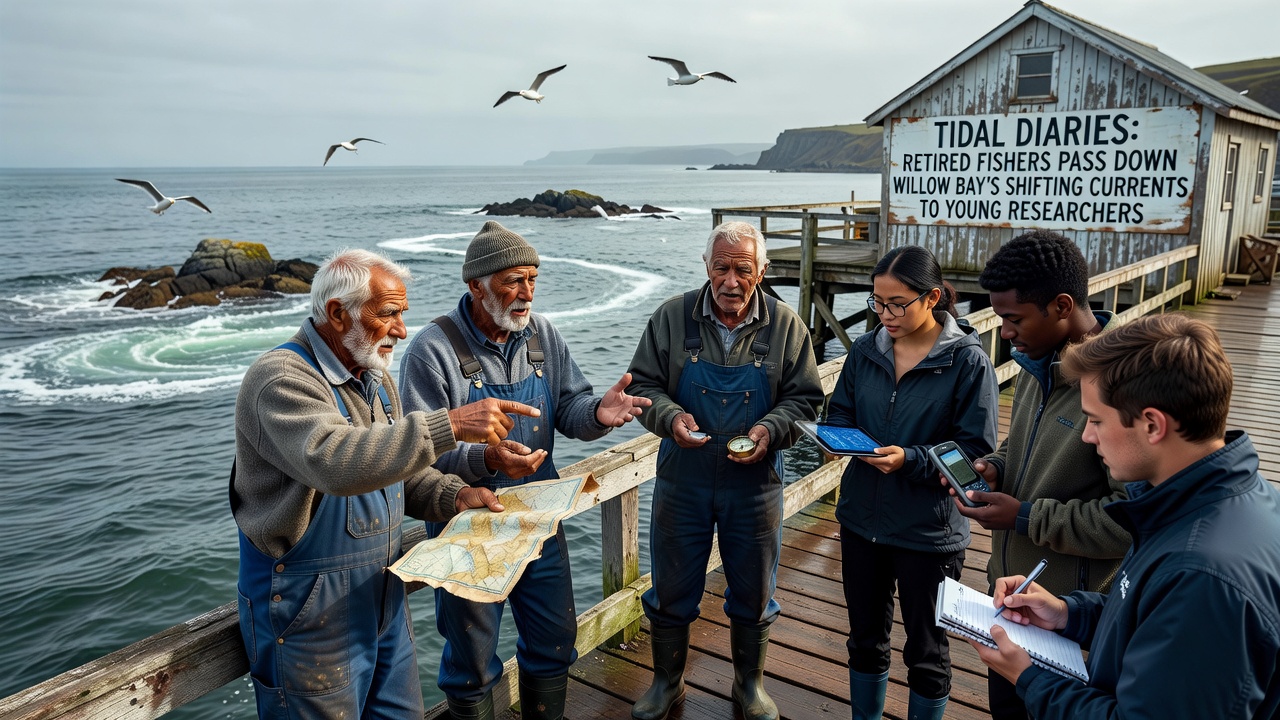
Each month a small group of retired fishers meets with early-career researchers at the Willow Bay harbor house, and conversations focus on specific entries that describe unusual current reversals during storm approaches. Young researchers bring sensor logs and bathymetric maps, while the fishers point out locations where eddies form that instruments sometimes miss. The October 2026 sessions will extend this format to include overnight observation trips, allowing participants to record conditions together and compare notes the next morning. Training materials developed for these meetings include glossaries of local terms for water movement and templates for translating diary entries into standardized data fields.
Contributions to Ongoing Research
Analysis of the diaries has already revealed patterns in winter current direction that differ from models calibrated only on post-2015 instrument data, and graduate students have incorporated these findings into three peer-reviewed papers submitted in 2025. The diaries also note changes in the timing of slack water near the central channel, and this information helps refine predictions used by the Willow Bay Port Authority for vessel scheduling. Researchers at the European Marine Observation and Data Network have requested access to the digitized collection for a comparative study of semi-enclosed bays in the northern hemisphere, and the request remains under review by the local archive board. Figures compiled from the first 120 volumes indicate an average increase of 12 minutes in the duration of ebb tide since 1985, a shift that aligns with broader regional observations but adds finer spatial detail.
Training and Documentation Practices
Young researchers learn to read the diaries by first shadowing fishers during routine walks along the breakwater, and they practice transcribing entries while noting context such as boat traffic or recent dredging. Each pair maintains a shared digital log that links diary pages to corresponding sensor timestamps, and the logs become part of the public dataset released quarterly. The October 2026 program will introduce a new module on uncertainty estimation, teaching participants to assign confidence levels to handwritten speed estimates based on weather descriptions in the same entry. Community volunteers handle transcription quality checks, and the archive center reports a 97 percent agreement rate between independent reviewers on numeric values.
Future Steps for the Initiative
Organizers plan to expand the Tidal Diaries collection by inviting additional retired fishers who worked outside the main harbor, and preliminary contact lists already contain 14 names from the eastern coves. Funding for the October 2026 workshops comes from a regional marine education grant that requires matching contributions from local businesses, and three charter operators have committed vessel time for field sessions. Data protocols developed during the project now serve as a template for similar knowledge-transfer efforts in two neighboring estuaries, and project coordinators have shared the templates at a 2025 coastal management conference. Continued digitization work will focus on cross-referencing entries with aerial photographs taken between 1978 and 2004 to verify reported changes in shoreline position.
Conclusion
The Tidal Diaries project demonstrates a working method for combining observational records kept by experienced fishers with contemporary measurement systems, and the approach continues to generate usable data for current modeling and port operations in Willow Bay. As the October 2026 workshops approach, the archive center expects additional volumes to enter the collection and further pairs of fishers and researchers to form. The resulting dataset remains available through the regional marine history center for any group conducting studies on semi-enclosed bay dynamics.